Will AI give digital health a second chance at ROI?
In chronic care management, digital health programs that augment routine care at home through coaching and remote monitoring are omnipresent. As of 2024, 82% of employers had made digital health solutions for chronic conditions available to employees. Yet, more than a decade after chronic care management was formalized for Medicare beneficiaries and digital care management solutions were developed for commercial populations, whether the savings from these programs exceed the costs remains unclear and may depend on the timeframe for analysis. Patients sign up for these programs for the accessibility, personalized product features, and free devices. Sponsors, mostly employers and payers, purchase these programs with the hopes of improving outcomes and reducing avoidable spend in high-cost conditions. The promise was fewer surgeries, hospitalizations, and ED visits because care management between visits would improve health behavior and slow disease progression.
Unfortunately, the return on investment (ROI) has lagged behind expectations. Many sponsors expected to see positive near term returns. However, engagement is a persistent challenge, outcome improvements are less clinically meaningful than anticipated, and cost savings often take years to materialize. In short, patients are often satisfied with these solutions, but whether the impact over a given timeframe justifies the cost is questionable.
The rapid rise of AI tools, and most recently agentic AI, offer the industry an opportunity to reimagine the design of digital health programs for chronic disease in a way that lowers costs and achieves at least the same, and hopefully better, outcomes - finally tipping the balance on return on investment.
The Problem: Low value, high cost digital health programs
Michael Porter described value in healthcare as the health outcomes achieved per dollar spent: value = outcomes/cost. Under this definition, there are multiple ways to derive value: for example, by improving outcomes and keeping costs the same or by lowering costs without worsening outcomes. To date, most digital health programs aim to improve outcomes through human-led virtual care that is technology-enabled. The cost of this model is high and the outcomes are either modest, often due to low engagement, or delayed, due to preventing future complications as opposed to near-term impact. This combination results in lower value than is desirable for sponsors who paid for the digital health program.
For companies that offer digital health programs, the high cost of human capital and the pressure from investors to support widespread adoption is a mismatch with the expectations of the health plans and employers who purchase these solutions. Digital health companies are incentivized to enroll as many members as possible and leverage the attraction of free devices and services to enroll patients. This results in a high influx of members who enroll for a single reason but may not want to engage with other aspects of the solution or have a stable disease and do not really need the services. Rock Health highlighted that 76% of people have “used” digital health, but for chronic disease management the majority of those surveyed (69%) still prefer in-person over virtual care.

The Peterson Health Technology Institute (PHTI) has published multiple reports highlighting that though digital health programs can provide some clinical benefit, the size of the impact often fails to outweigh the fees. They argue that to demonstrate value, companies offering digital programs need to adopt new models that ensure not just outcomes but also cost savings, such as by linking fees to engagement, providing performance guarantees on outcomes, and offering fees that are lower than the medical costs they offset (the “net savings” test).
The Solution: Lower cost, more effective, AI-forward care
Recent advances in agentic AI bring an opportunity to redefine care models underpinning digital health programs to be AI-forward, meaning some workflows and engagements would be driven by technology, to realize a greater return on investment and generate lasting value. Companies can now imagine AI agents that can augment clinical reasoning and, under guardrails, act on behalf of a clinical staff member for certain care management tasks, such as behavioral coaching, goal-setting, and motivational interviewing. If AI-forward workflows can be shown to be at least as effective, reliable, safe, and engaging as existing human staff, companies can lower the amount of human capital resources, reducing costs and enabling programs to scale with little incremental spend. Additionally, AI-forward care can be used to achieve greater personalization, ingesting complete medical histories, remembering patient preferences, and reviewing health data in real time to suggest care plan modifications for individuals as soon as they are needed. Essentially, agentic AI could help digital health programs deliver the right intervention, to the right person, at the right time - possibly improving engagement and delivering better outcomes.
The opportunity to redesign care models to be AI-forward is quickly becoming a reality. Alongside rapid technical advancements, new policy initiatives also intend to accelerate the adoption of lower cost, AI-forward digital health. The Centers for Medicare and Medicaid Services (CMS) recently announced the ACCESS (Advancing Chronic Care with Effective, Scalable Solutions) Model, marking the first time the federal government has created a dedicated, scalable pathway to pay for digital health programs in chronic care. Notably, the payment model intends to reward value creation by offering modest payment rates (no more than $28/mo/patient) and conditioning those payments on clinically meaningful improvement in outcomes. This payment structure is a bold challenge to the industry to rapidly embrace an AI-forward care model. And, while the ACCESS Model will be initially tested in the Original Medicare population, many major payers have already pledged to adopt similar payment models for commercial populations in the upcoming years.

What’s next? Outcome-driven, targeted and integrated AI-forward care
Though routine, in-person visits will continue to be led by human care teams leveraging technology to be maximally efficient and effective, this is no longer the model for between visit chronic care management. For digital health companies, the assignment is now clear: AI is out in front.
At Verily, the front door of digital health at home can be an immersive, effective experience driven by AI rather than being restricted to a human provider. Humans remain on the loop as a vital part of monitoring and escalation, but patients in these programs no longer need to wait for business hours to get answers to questions about their care plan, can engage in unlimited long two-way conversations around lifestyle modification and health goals, and may be able to instantly refill their medications when their health status is stable and labs are up to date.

We understand expectations around value moving forward, so we are prioritizing 3 key elements for our care model to maximize our program ROI for both the patient and the purchaser:
1. Payment dependent on outcomes
Following the recommendations of PHTI and CMS ACCESS, our monthly fees for Verily Lightpath chronic care management programs are linked to meaningful user engagement, and we commit to performance guarantees linked to population health outcomes tailored to our customer’s goals. For example, some customers may seek robust within-year impact on outcomes, where others take a longer-term outlook on savings.
2. Whole-person, personalized AI-forward care
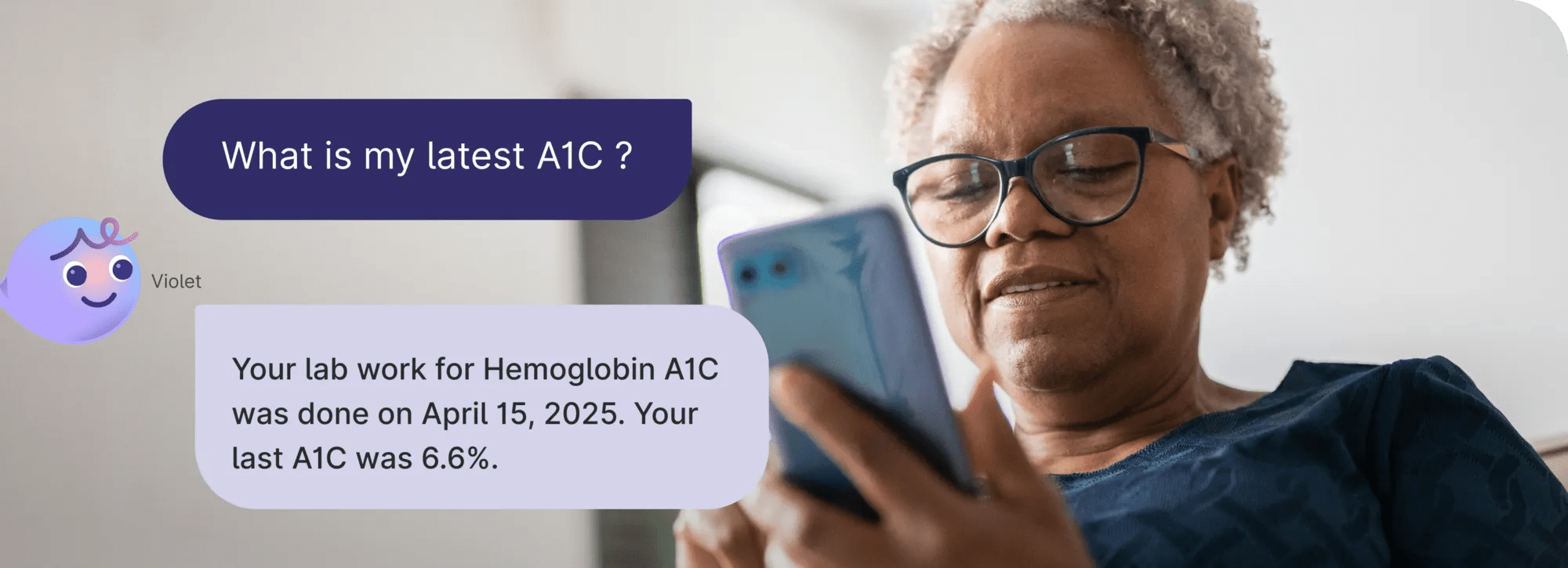
Our Verily Me app includes Violet, an AI companion, that will work with patients to set health goals, monitor progress, and educate regarding a wide array of health conditions. Through the use of data insights and in-app behavior, Violet aims to enable whole-person, personalized care that works for everyone. In concert with remote monitoring and telehealth when needed, workflows and member engagement that is driven by AI rather than the human care team can lower program costs and have the potential to improve engagement.
3. Integration and targeted program configurability
Our digital health programs are built on the Verily Pre Platform, a comprehensive data engine that ingests and harmonizes health data from multiple sources. As a member’s available health records are connected to Lightpath, Verily Pre is able to extract data from clinician notes to create a more complete health profile. AI agents built on this platform use the comprehensive and organized data to further personalize conversations, make more informed care recommendations, and improve care coordination through bidirectional exchange of health care data with a patient’s other healthcare providers. Additionally, the Pre platform enables us to configure our programs to meet the unique needs of each customer, targeting segments of their population that are most likely to benefit. For example, for an employer client that can accept a positive ROI in 3-5 years, we may configure a diabetes program broadly to address all stages of disease. Whereas for a fully-insured health plan that needs an ROI within 1-2 years, we can target our program to their patients with the highest risk level.
Conclusion
With the advancing capabilities of agentic AI and growing momentum to adopt value-based payment for digital health, the industry is finally equipped to bridge the gap between patient satisfaction and ROI. The shift from human-intensive care to AI-forward, integrated solutions ensures high-quality care management is both scalable and fiscally sustainable. Though there is much to be done to realize the vision, the path forward is clear. Digital health companies have been given a second chance to prove that digital health programs, delivered at home, can result in both meaningful clinical outcome improvement and cost savings as promised.
*The information contained on this page is intended to outline Verily’s general product direction and is not a commitment or legal obligation to deliver any functionality. Product capabilities, timeframes and features are subject to change and should not be viewed as commitments.